
-
- Digital Marketing
-
 Perf. Marketing
 E-mail Marketing
 PPC Services
 Video Marketing
 Influencer Marketing
- Social Media
 Facebook Marketing
 Instagram Marketing
 Twitter Marketing
 Pinterest Marketing
 TikTok Marketing


-
- Digital Marketing
-
Perf. Marketing
- E-mail Marketing
- PPC Services
- Video Marketing
- Influencer Marketing
- Social Media
- Facebook Marketing
- Instagram Marketing
- Twitter Marketing
- Pinterest Marketing
- TikTok Marketing
Blog
Difference Between SEO and SEM: Organic vs Paid Search Explained
Want a Quick Summary?
Summarize this article instantly with ChatGPT.
For businesses navigating the world of digital marketing, two acronyms come up again and again: SEO and SEM. Both are related to search engines, both are designed to increase your visibility in search results, and both can drive significant traffic to your website yet they are fundamentally different in their mechanisms, timelines, costs, and strategic applications. Understanding the difference between SEO and SEM is essential for any business looking to invest intelligently in search visibility and make informed decisions about where to allocate marketing budgets for maximum return.
This guide provides a clear, comprehensive explanation of both disciplines, examines the key differences between them, and explores how smart businesses use them in combination to maximise their search engine presence across both organic and paid channels.
What Is SEO?
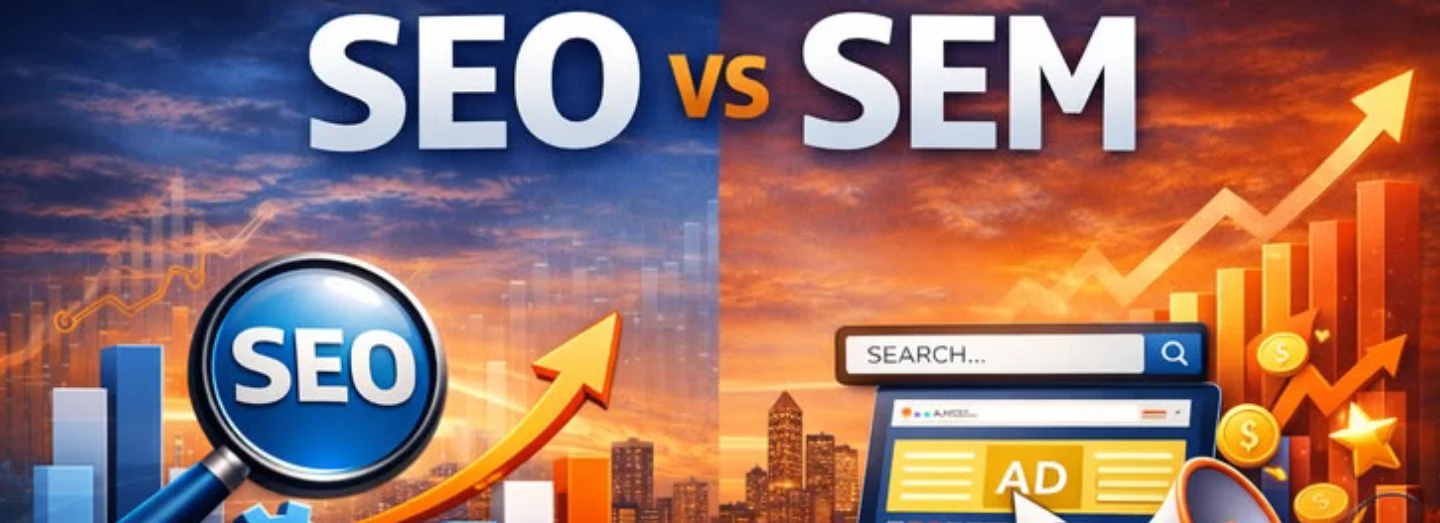
SEO (Search Engine Optimisation) is the practice of optimising a website and its content to earn higher rankings in organic (unpaid) search engine results. When someone conducts a search on Google, the organic results the non-advertising listings that appear based on Google's assessment of relevance and authority are what SEO works to influence. Organic results are earned through merit: by creating high-quality content, building a technically sound website, earning authoritative backlinks, and demonstrating expertise and trustworthiness in your subject area.
SEO is a long-term strategy. It typically takes several months of consistent effort before the full impact of SEO activities is visible in rankings and traffic. However, the results are durable once earned, organic rankings tend to persist as long as the site continues to be maintained and improved, providing a compounding return on investment over time. A business with strong organic rankings earns traffic without paying for each individual click, making SEO one of the most cost-effective customer acquisition channels available when viewed over a multi-year time horizon. Expert SEO services in Dubai combine technical expertise, content strategy, and link building to build this organic presence systematically.
What Is SEM?
SEM (Search Engine Marketing) is a broader term that, in modern usage, most commonly refers to paid search advertising specifically Google Ads (formerly Google AdWords) and equivalent paid search platforms like Microsoft Advertising (Bing Ads). Through SEM, businesses bid on keywords and pay to have their advertisements appear in prominent positions within search results pages, typically at the top and bottom of the page marked with a small "Sponsored" label.
SEM delivers immediate visibility. Within hours of setting up a campaign, your ads can appear for your target keywords and begin driving traffic to your website. There is no waiting period for rankings to develop if you bid competitively and your ad quality is sufficient, you can be visible for your most important keywords essentially overnight. However, this visibility comes with a direct cost: you pay for every click your ads receive, and your visibility disappears the moment your campaign budget is exhausted or your bids are outcompeted.
It is worth noting that some definitions of SEM include SEO as a subset of search engine marketing treating SEM as the umbrella term for all search-related marketing activity. In current industry usage, however, SEM most commonly refers specifically to paid search advertising, and this is the distinction this guide addresses. Many businesses working with a full-service digital marketing agency invest in both channels as complementary components of a comprehensive search strategy.
Key Differences Between SEO and SEM
Cost Structure
SEO requires upfront investment in time, expertise, content creation, and link building, but does not involve paying for individual clicks or impressions. Once rankings are achieved, traffic flows without additional per-visitor cost. SEM involves paying for every click (cost-per-click model) or every thousand impressions (CPM model). SEM budgets can scale quickly in competitive markets where click costs are high keywords like "business insurance Dubai" or "personal injury lawyer UAE" can carry costs of tens of dollars per click.
Timeline to Results
SEM delivers immediate results campaigns can go live within hours and begin generating traffic almost instantly. SEO is a long-term investment meaningful ranking improvements typically take three to six months to materialise, and building true organic authority in competitive markets can take a year or more of consistent effort. For businesses with urgent traffic needs, SEM provides immediate presence while SEO builds the long-term organic foundation.
Position and Appearance in Search Results
SEM ads appear at the very top of search results pages (above organic results) and at the bottom, clearly marked as "Sponsored" or "Ad." This premium position is highly visible but carries the stigma in the eyes of some users of being paid for. Organic SEO results appear below the paid ads and are generally perceived as more credible and trustworthy by users, though they occupy lower positions on the page by default. Studies consistently show that the majority of clicks go to organic results, though ads can capture significant clicks for specific query types particularly transactional and commercial queries.
Sustainability and Compounding Returns
The results of SEO accumulate and compound over time. As domain authority grows, new content ranks faster, existing content holds its positions more securely, and the long-term cost of generating organic traffic decreases. SEM, by contrast, does not compound your campaign performance is a function of current budget, bid competitiveness, and quality score, with no lasting benefit from past spend. This makes SEO fundamentally more sustainable as a long-term traffic strategy, while SEM is most valuable as an immediate, controllable traffic source. Businesses integrating SEO with broader performance marketing strategies maximise the complementary strengths of both organic and paid channels.
Targeting Capabilities
SEM offers remarkably precise targeting capabilities. You can target specific geographic locations, time of day, device type, audience demographics, and even remarketing lists (targeting users who have previously visited your website). These granular controls make SEM particularly effective for time-sensitive promotions, geographic targeting, and reaching specific audience segments. SEO's targeting is more organic you attract the users who search for the terms you rank for, with less direct control over other demographic or behavioral characteristics.
Keyword and Content Flexibility
With SEM, you can immediately appear for any keyword simply by creating a campaign and bidding for it. With SEO, appearing for a keyword requires building the content and authority signals needed to earn organic ranking which takes time but creates more permanent and broadly applicable visibility across many related queries. SEO keyword coverage tends to be broader and more comprehensive over time, while SEM keyword coverage is precisely defined by your active campaigns.
How SEO and SEM Work Together
The most effective search marketing strategies use SEO and SEM as complementary tools rather than choosing one over the other. SEM provides immediate visibility and cash flow from search traffic while long-term SEO authority is being built. Once organic rankings are established for key terms, SEM budgets can be shifted away from those terms toward new opportunities, reducing overall paid spend while maintaining total search visibility.
SEM data is also invaluable for SEO strategy. The keyword performance data from paid campaigns particularly which terms drive the highest conversion rates helps prioritise SEO content development. SEM allows you to test which page messaging and calls-to-action convert best before committing to them in your organic content. And for high-value keywords where both organic and paid results appear, having presence in both positions dramatically increases the probability that a searcher will click through to your site. The technical SEO team at BrandStory works closely with paid search specialists to ensure both channels are aligned and mutually reinforcing.
Which Should You Prioritise?
For businesses with an immediate need for traffic and leads a new business launching, a time-sensitive promotion, or a company that has not yet built organic authority SEM should be the priority in the short term. For businesses with a medium-to-long-term perspective who want to build a durable, cost-effective organic presence that compounds over time, SEO should be the primary strategic investment, with SEM used tactically to supplement.
Most established businesses benefit from investing in both simultaneously using SEM to capture immediate high-intent traffic and generate revenue while SEO builds the organic foundation that will reduce their dependence on paid channels over time. This balanced approach, guided by an expert SEO company in Dubai, creates a resilient search presence that performs across both organic and paid channels.
Conclusion
SEO and SEM are two of the most powerful tools in a digital marketer's arsenal, and understanding their differences in cost structure, timeline, sustainability, and strategic application is essential for making intelligent investment decisions. SEO builds a durable, compounding organic presence that delivers increasing returns over time. SEM delivers immediate, controllable visibility with precise targeting at a direct per-click cost. Used together strategically, they create a comprehensive search presence that captures the full range of opportunities available in both organic and paid search results. Whether your priority is immediate traffic or long-term organic dominance, working with an experienced digital marketing partner ensures your search strategy is optimised for your specific goals and market context.
Looking for Measurable Business Growth?
Partner with BrandStory for end-to-end digital & creative excellence.


Are You Looking for Growth?
Free instant digital marketing audit and improve performance.
Get Graded Today
Transform Your Digital Growth with BrandStory
From SEO, PPC, social media marketing, and content marketing to website development, branding, and lead generation, BrandStory delivers result-driven digital marketing services in Dubai and across the UAE, helping businesses attract, engage, and convert more customers.
Trusted by 1000+ leading brands in Dubai and globally including:




Related Blogs

How to Fix Mobile Usability Issues: Step-by-Step Technical Guide
With Google operating entirely on mobile-first indexing, search engine crawlers assess, index, and rank web pages base...

How to Fix JavaScript SEO Issues: Complete Technical Guide
Modern web development relies heavily on JavaScript frameworks like React, Next.js, Vue, Angular, and Nuxt to build ri...

How to Fix Soft 404 Errors: Complete Technical SEO Guide
A Soft 404 error occurs when a web server responds with an HTTP 200 OK status code signaling success, but search engin...

How to Set Up Hreflang Tags: Technical SEO Implementation Guide
The hreflang attribute is an HTML specification that informs search engines about the language and geographical target...

How to Fix Mixed Content Errors: Complete Security Guide
A mixed content error occurs when an initial webpage loads securely over HTTPS, but subresources such as images, scrip...

How to Fix Missing Meta Descriptions: Complete SEO Guide
A missing meta description occurs when an HTML document lacks a <meta name="description"> tag in its <head>...

